

In this guide ▾
- How the criminal record check works
- Which convictions can stop you
- Serious offences that usually lead to refusal
- What you must declare when you apply
- If you already hold a licence
- Check your position before booking
- What changed on 1 December 2025
- Frequently asked questions
- Check your record before you commit
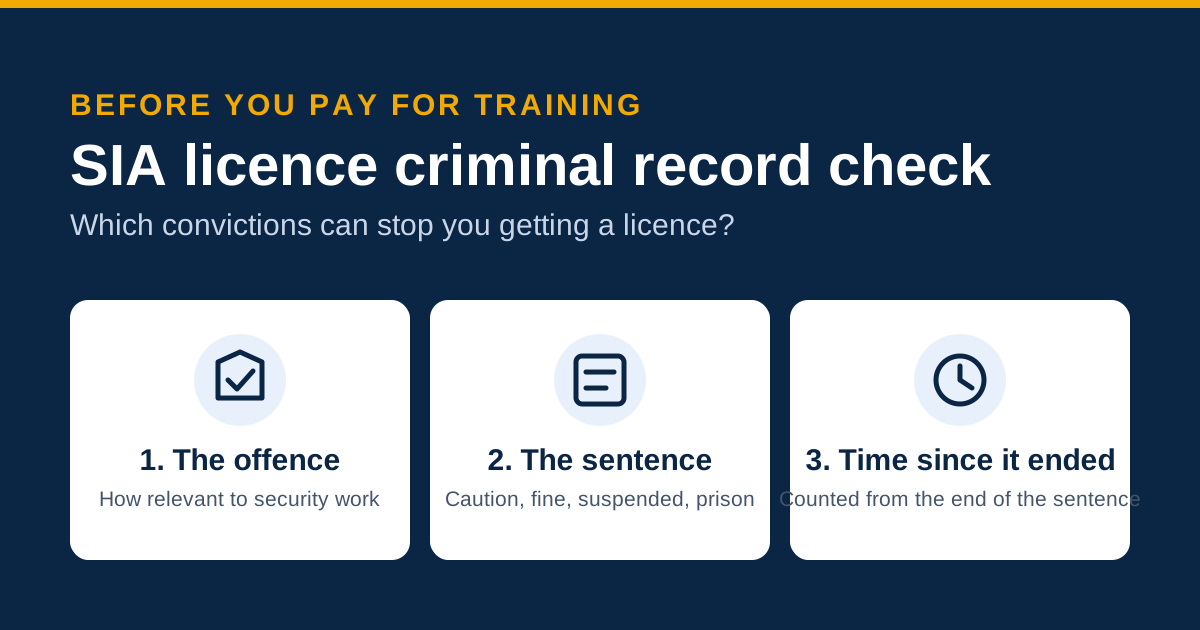
The SIA licence criminal record check looks at every applicant’s record, but a conviction does not automatically stop you getting a licence. The Security Industry Authority (SIA) looks at three things: how relevant the offence is to security work, the sentence you received and how long ago it ended.
Some outcomes lead to refusal, particularly recent prison sentences and sexual or child abuse offences. The same criteria apply across the UK. If you are still at the planning stage, our guide to how the SIA application works shows where the check fits.
How the SIA licence criminal record check works
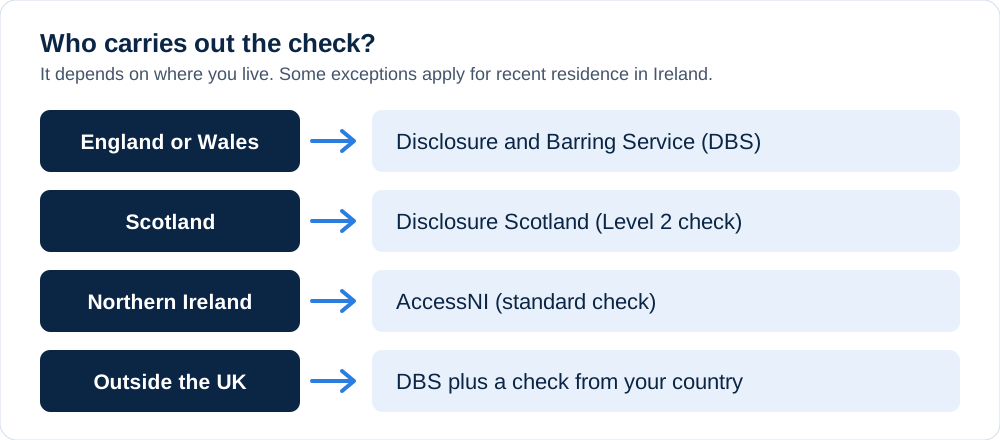
The SIA checks the criminal record of every applicant. Which body carries out the check depends on where you live:
- England or Wales: the Disclosure and Barring Service (DBS), unless you lived in Northern Ireland or the Republic of Ireland in the last five years.
- Scotland: Disclosure Scotland, which carries out a Level 2 check, unless the AccessNI rule applies.
- Northern Ireland, or the Republic of Ireland within the last five years: AccessNI, through a standard check.
- Outside the UK: the DBS, plus a criminal record check from the country where you live.
The SIA can see unspent convictions and cautions and some spent ones, subject to filtering rules. It judges relevance using 25 offence categories. These include violent or abusive behaviour, dishonesty such as theft and fraud, drug offences, sexual offences and public order offences.
Which convictions can stop you getting an SIA licence
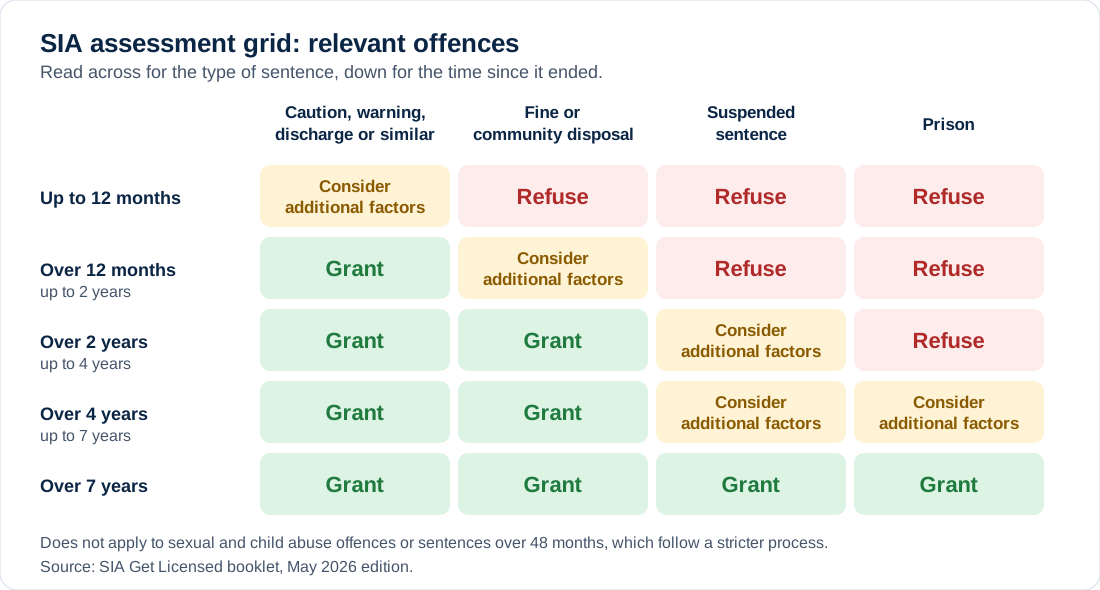
For most relevant offences, the SIA looks at the type of sentence and how long ago the sentence restrictions ended. This table comes from the SIA’s Get Licensed booklet (May 2026 edition), where it is called the assessment grid. Read across for the type of sentence and down for the time since it ended.
| Time since sentence restrictions ended | Caution, warning, discharge or similar | Fine or community disposal | Suspended sentence | Prison |
|---|---|---|---|---|
| Up to 12 months | Consider additional factors | Refuse | Refuse | Refuse |
| Over 12 months, up to 2 years | Grant | Consider additional factors | Refuse | Refuse |
| Over 2 years, up to 4 years | Grant | Grant | Consider additional factors | Refuse |
| Over 4 years, up to 7 years | Grant | Grant | Consider additional factors | Consider additional factors |
| Over 7 years | Grant | Grant | Grant | Grant |
The table does not apply to sexual and child abuse offences or to sentences over 48 months, which follow the stricter process described below.
How the clock runs
The time is counted from different points depending on the disposal:
- Prison: from the end of the sentence, not from sentencing. Early release does not shorten it.
- Suspended sentence: from the end of the sentence period, not the suspension period.
- Community order: from the end of the order.
- Fines, cautions, warnings, discharges and similar: from the day after the disposal was imposed.
What additional factors involve
Considering additional factors means the SIA asks for more information before it decides. It looks at your whole record, and a pattern of offending over several years counts for more than a single episode.
You can send signed, dated character references with a contact number, and evidence of rehabilitation such as voluntary training. The SIA does not take your financial situation into account.
Multiple convictions
The booklet has separate rules for more than one conviction or disposal. In some combinations the SIA refuses automatically, and in others it considers additional factors. If you have more than one, read the booklet’s section on multiple convictions and consider taking legal advice.
Serious offences that usually lead to refusal
For sexual and child abuse offences, including child neglect, the SIA will normally refuse a licence on public protection grounds. This applies however long ago the offence happened. For a prison sentence over 48 months, including life, it will not automatically grant a licence however much time has passed.
In both cases the SIA writes to say it intends to refuse. You then have 21 days from the date of its letter to provide evidence of exceptional circumstances showing you are not a current risk. If you send nothing, the SIA confirms the refusal.
The SIA will not grant a licence to anyone who:
- is currently subject to sex offender notification requirements;
- is under a sexual harm prevention order or sexual risk order;
- has more than one adult conviction or other disposal for an offence the booklet marks with an asterisk, which covers sexual and child abuse offences;
- has a conviction for a sexual offence committed while working as a licence holder or in a role of trust or responsibility.
Equivalent notification and control requirements in Scotland and Northern Ireland count for these rules. If your record falls in this category, consider taking legal advice before you apply.
What you must declare when you apply
You must declare outstanding charges for relevant offences. You must also declare any known investigation into possible relevant offences or misconduct, whether by the police or by a public or professional body. GOV.UK says the SIA will ask for evidence such as a letter or court document showing all the offences charged and the court date.
The SIA may wait for the outcome before it decides. It reviews a held application every three months and withdraws it if the matter is still unresolved one year after you applied. For sexual or child abuse offences, it advises waiting for the outcome before you apply.
See how the SIA application works for the full process. You will also need acceptable identity documents, so read our guide to the documents you must bring.
If you already hold a licence
Licence holders must tell the SIA within two calendar days of any conviction, caution, warning or charge for a relevant offence. Missing that deadline means breaking the conditions of the licence.
A new sentence or disposal for a relevant offence can lead to the SIA revoking the licence, using the same approach as for applications. The same criminal record criteria apply when you renew, so check your position before you book a door supervisor refresher or security guard refresher.
Check your position before booking a course
The SIA’s Criminal Record Indicator indicates if you would pass the criminality check, based on the offences you enter. Include every offence, spent convictions too, because the SIA can consider them. The result is an indication only and does not guarantee the outcome of the check made when you apply.
Do not use the indicator if you have charges awaiting trial, a life sentence, juvenile convictions or overseas convictions. The same applies to ancillary orders and to hospital, restriction or compulsion orders. These cases need special consideration.
Course fees are a separate cost from the SIA application fee. Checking your position first is sensible before you pay for the SIA door supervisor course, the SIA security guard course, the SIA CCTV course or close protection training.
What changed on 1 December 2025
The SIA’s announcement set out these changes for applications from 1 December 2025, including renewals:
- a wider list of relevant offences, with modern slavery, people trafficking and upskirting given as examples;
- refusal for sexual, child abuse or neglect offences, or sentences over 48 months, unless the applicant can show they are not a public protection risk;
- an overseas criminal record check for anyone who has lived overseas for six continuous months or more in the last ten years, up from five years;
- a clearer statement that the SIA may consider other information, such as domestic violence orders and misconduct or disciplinary proceedings.
GOV.UK says the May 2026 booklet was reissued with no content changes.
Frequently asked questions
Can I get an SIA licence with a caution?
For a relevant offence, the SIA considers additional factors in the first 12 months, and the table shows a grant after that. Sexual and child abuse offences follow the stricter process, and several cautions or convictions together can change the outcome. See our guide on how the SIA application works for the wider process.
Can the SIA see spent convictions?
It can see unspent convictions and cautions and some spent ones, subject to filtering rules. That is why the Criminal Record Indicator asks you to include spent convictions.
Do convictions from childhood count?
Records from ages 10 to 12 are considered not relevant unless they relate to offences originally treated as serious. Relevant offences from ages 12 to 17 are assessed on a separate table for under-18s.
Does time on remand count?
Time on remand can count towards the calculation if you provide evidence, ideally with your application. In Scotland, it is normally taken into account at sentencing.
Conclusion: check your record before you commit
A record does not rule you out. The type of offence, the sentence and the time since it ended decide the outcome. Use the SIA’s indicator and booklet to check your position before you pay for training.
If you want to talk through course options before booking, speak to our team. Only the SIA can decide if you are granted a licence. You can also read more guides on our blog, or see our London and Glasgow training pages.
Ready to book your SIA course?
Check your position first, then choose the course that matches the licence you want.