
In this guide ▾
- SIA course requirements at a glance
- Minimum age for SIA training
- English language requirement
- ID checks before you start
- First aid for SIA courses
- Other things your provider may ask
- Worked example: preparing for a January course
- Course entry is separate from getting a licence
- Frequently asked questions
- Get your documents in order first
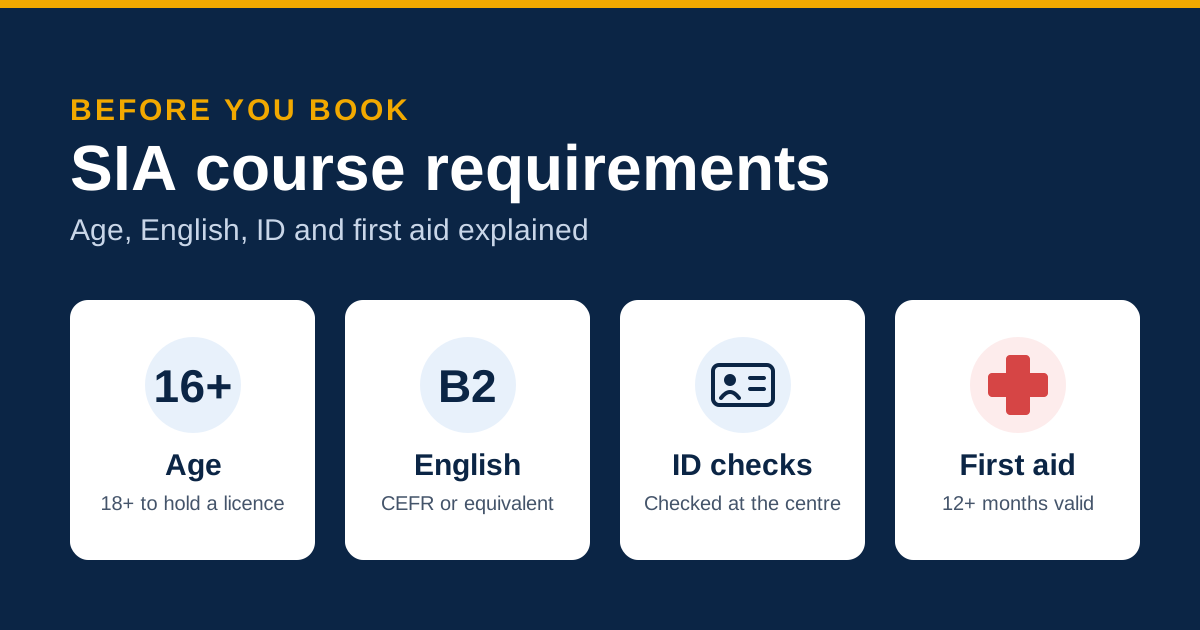
SIA course requirements are set by the Security Industry Authority (SIA) and checked by your training provider before you can be assessed. Door supervisor and security guard learners need a first aid certificate, acceptable identity documents and a good enough level of English. Age limits depend on the course.
The rules apply across the UK, although qualification names differ in Scotland.
SIA course requirements at a glance
| Requirement | Door supervisor | Security guard | CCTV operator |
|---|---|---|---|
| Minimum age to enrol | 18 | 16 | 16 |
| Minimum age to hold the licence | 18 | 18 | 18 |
| First aid certificate before training | Yes | Yes | Not required |
| English at CEFR level B2 or equivalent | Yes | Yes | Yes |
| Identity check by the training centre | Yes | Yes | Yes |
These details come from the SIA’s requirements for training centres. CEFR stands for the Common European Framework of Reference for Languages.
Minimum age for SIA training
You must be 18 or over to hold any SIA licence. The same age limit applies to enrolling on door supervisor, close protection and cash and valuables in transit training. Learners aged 16 and 17 can enrol on security guard and CCTV courses. Training centres must tell them they cannot hold a licence until they turn 18.
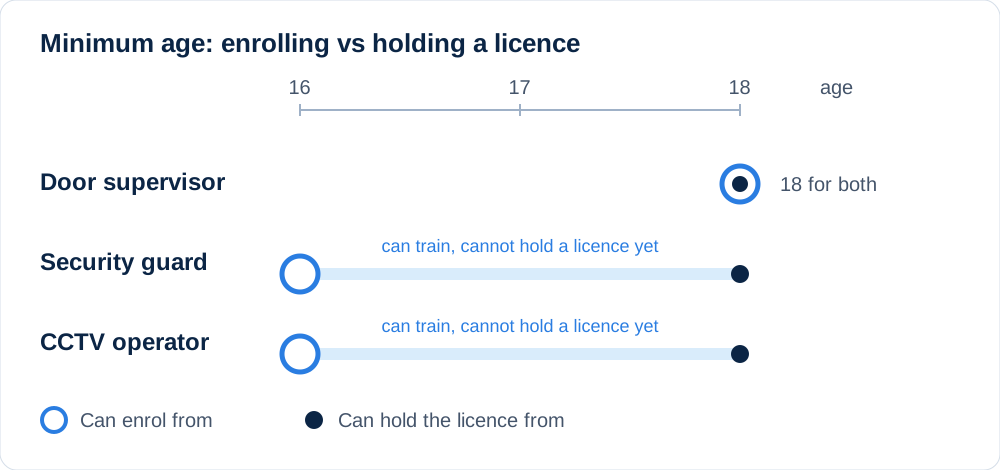
Under the SIA’s rules, a 17-year-old can enrol on the SIA security guard course but not on the SIA door supervisor course, which is open only to adults. Providers can set their own entry rules, so check that yours accepts learners under 18. Younger learners do not have to video record their practical assessment, and the centre provides other evidence instead, such as a transcript.
English language requirement for SIA training
Your provider must be satisfied that your reading, writing, speaking and listening are good enough before you are put forward for training and assessment. The SIA sets the standard at B2 on the CEFR, or an equivalent such as:
- a B2 qualification on the Home Office’s list of recognised English tests and qualifications;
- an English for Speakers of Other Languages (ESOL) qualification at Level 1 on the Ofqual register, taken in England, Wales or Northern Ireland;
- an ESOL qualification at Scottish Credit and Qualifications Framework (SCQF) Level 5, awarded by the Scottish Qualifications Authority (SQA) and taken in Scotland;
- Functional Skills Level 1 in English;
- SQA Core Skills in Communication at SCQF Level 5;
- Essential Skills Wales Communication Level 1.
If you do not hold one of these, you can still ask the provider how it checks English. Centres use assessments agreed with their awarding organisation and must record the result for all four skills.
ID checks before you start
The training centre must check your identity before it assesses you. It must keep a record of the documents it accepts for at least three years and store your data in line with data protection law.
If you cannot produce documents that meet the SIA’s requirements, you cannot take any assessments and so cannot complete the qualification.
The SIA says awarding organisations should tell centres which forms of ID are acceptable, and that this will reflect its list of acceptable identity documents. Ask your provider for its list before the first day, and see Security Training UK’s guide to the documents you must bring.
GOV.UK’s application page shows the identity documents the SIA accepts for a licence application, which helps when you start gathering yours.
If you do not have the documents, contact the SIA through your SIA online account. Explain why you do not have them and which documents you do hold. The SIA assesses each case individually.
First aid for SIA courses
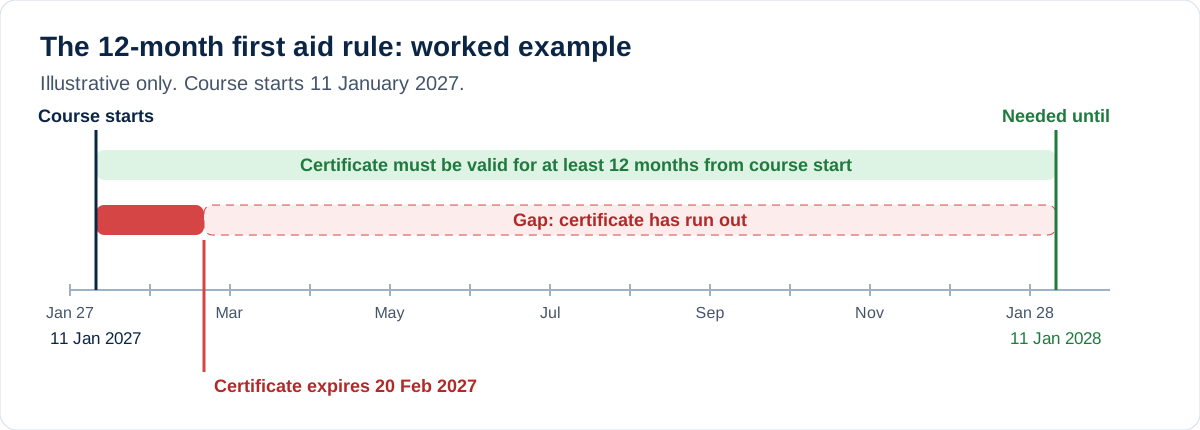
Door supervisor and security guard learners must show a current first aid certificate to their provider before the course starts. It must be valid for at least 12 months from the course start date. The centre checks it and keeps a record.
If yours is too close to expiry, you can book an Emergency First Aid at Work course first. Our first aid training page lists the options, including the longer 3-day first aid course.
Close protection learners need a Level 3 first aid qualification, completed before the course begins. The SIA’s training rules do not require first aid for CCTV, cash and valuables in transit, or vehicle immobilising learners.
Other things your provider may ask
- You sign a declaration that you are fit to take part in practical skills training, and the centre must make sure you do.
- You should receive safety information before the course, covering physical risks, expected behaviour, clothing and what to do about health or fitness concerns.
- You must be given enough time to finish any self-study before the course begins.
- You sign the centre’s attendance register each day. If you arrive late or leave early, the centre records how you make up the missed hours.
- Providers must make reasonable adjustments for disabled learners, and the SIA’s requirements refer to the Equality Act 2010. Tell your provider early if you need one, for example by contacting our team.
Worked example: preparing for a January course
This example is illustrative, not a real case. You want to start a security guard course on 11 January 2027.
- Your first aid certificate expires on 20 February 2027. That is under 12 months after the course starts, so you book new first aid first.
- You ask the provider which identity documents it accepts, then gather them.
- You ask how the provider assesses English and bring any qualification from the list above.
- You confirm your age: at 16 or over, you can enrol on the guard course.
- You finish any self-study before the first day.
Course entry is separate from getting a licence
Meeting the entry requirements lets you train, but a licence is decided separately. The SIA’s requirements for training centres say not every learner put forward for training will be eligible for a licence. They add that physical ability can matter for some roles.
The SIA decides each application separately, checking your identity, criminal record and right to work. If you have a conviction, caution or pending charge, read the criteria in the SIA’s Get Licensed booklet before you pay for a course. For more guides on getting and keeping a licence, visit our blog.
Frequently asked questions
Does English assessment time count towards course hours?
The SIA does not count time spent assessing English language skills as contact time, so it sits outside the minimum course hours.
Can I be assessed in Welsh?
SIA assessment must take place in English, Welsh or both, and the language requirement applies to either. Ask your provider whether it offers Welsh.
Which first aid certificates do centres accept?
Door supervisor and security guard learners need a current first aid or emergency first aid certificate. It must meet the Health and Safety (First Aid) Regulations 1981. The Get Licensed booklet names Emergency First Aid at Work following Health and Safety Executive requirements. You can book a 1-day first aid course if you need one.
Do I need the right to work in the UK before I train?
The SIA’s requirements say learners must have the right to work in the UK to get a licence, so check yours before you pay. The SIA can also check this during your application.
Conclusion: get your documents in order first
Before you pay for a course, check your first aid expiry date, your identity documents and how your provider assesses English. Your age only decides which course you can enrol on.
To confirm the qualification that matches your licence, read GOV.UK’s guidance on what training you need.
When you are ready, compare our door supervisor, security guard, CCTV and close protection courses. Already licensed? See the door supervisor refresher or security guard refresher.
We run SIA training in London, Glasgow, Edinburgh, Aberdeen, Dundee and other towns. If you are unsure which course or documents apply to you, contact our team.
Ready to book your SIA course?
Check your documents, then choose the course that matches the licence you want.